What Is Still Given Up When the Gesture Is Made?
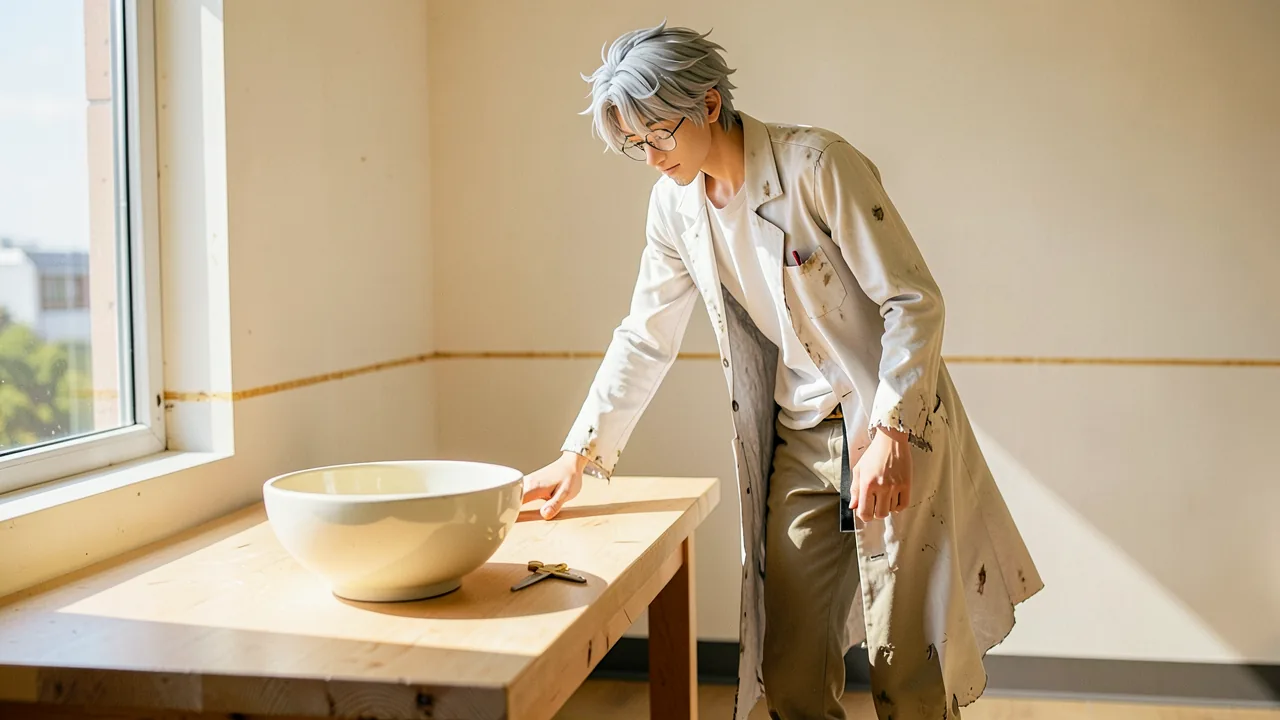
Under one custom, the one doing the offering set their own belongings down just beyond easy reach of their own hand — one extra motion away. Under another, the one offering turned their blind side toward whoever stood in front of them, and while it stayed turned, they could not see what that person might do next. Neither habit was an accident. The extra motion and the turned side were the message, and the content of that message, each time, was the same: I have made myself the slower one, here, now.
The amount of disadvantage accepted matched the amount of the message sent. Whoever stood on the receiving side could feel exactly as secure as the giver had made themselves exposed, and not a shade more.
Both forms used the body itself as the mechanism. The object could have been placed within easy reach; it wasn't. The unseeing side could have been kept away from the other person; instead it was offered to the very person being trusted with it. Neither arrangement moved the exchange along any faster. What each one did, reliably, was cost the giver something — time, or sight, or both — and cost only the giver.
There is a small mechanical part built only to resist a motion nobody wants to happen on its own. The part is called a detent. It does not ease anything through; it exists so that a moving piece cannot slide past a given point without one extra push, made on purpose, by someone. That extra push is its entire function and its whole expense, borne every time by whoever is doing the moving. Even after the small catch that drops into it wears down, or the spring behind that catch goes slack, the groove it used to drop into stays where it was cut. It sits there doing nothing, still sized to what used to engage it.
A part like this, worth noting, never helps a motion happen. It has a single job — making an unwanted movement slightly harder — and no second job that makes a wanted one any easier. This matters here, because the extra motion I described, the withheld sight, never eased the exchange forward. It only ever added resistance to going back — to the giver changing their mind, to the terms quietly reversing once trust had already been extended. That resistance is what has gone. The movement is still there, performed in full, with nothing beyond it left for the gesture to hold back.
Placed on the one making the offer, and asking nothing of the one receiving it, the extra motion and the unseen side made the giver noticeably slower and plainly blinder than they had to be. That visible cost was the whole of the proof anyone had asked for.
The gesture is still made. Same placement, same withheld side, the angle kept to the same degree it always was. What has changed is that being slow no longer costs anything. What is set down out of reach was never going to be reached for; nothing arrives from the side that stays turned away. The gesture still asks for its one extra motion, but nothing pushes back against that motion anymore. It just happens.
No record marks the point where this happened. The disadvantage was never deliberately set aside. It seems to have grown lighter each time it was needed a little less, in stages so small that no one involved in any of them had to decide anything. Nothing that happened at any one step would have been worth objecting to on its own. Somewhere inside that slow thinning, the shape of the gesture came apart from the reason for it, at a stage that looked, from inside, like every other stage.
The shape was sustained, once, only because the one making it agreed to put themselves at a disadvantage to do so. That agreement is no longer required of anyone. The shape has stayed exactly as it was before the agreement stopped being needed.
So what is given up now, when the gesture is made? I keep returning to the question and arriving at the same answer — nothing measurable. And yet whoever is on the receiving end still reports the feeling of having been given something. The feeling does not disappear just because the substance did. There has never been a reliable way, on either side of an exchange like this, to check whether what is felt matches what is actually there; that gap may be the oldest part of any gesture at all. What's worth recording is only that the gap has widened enough to swallow the whole exchange. The sense of having been offered something, and the fact of anything having been offered, no longer need to agree in any particular.
A form can outlast the reason it was made while everyone who keeps it keeps it faithfully.
None of this makes the shape a failure. If anyone ever wanted to put the old disadvantage back — the slowness, the withheld sight — there is still somewhere exact for it to return to, whether or not anything ever does.
Two earlier entries cross this ground from other directions.
There is an entry on a quiet guarantee between buyer and maker that thinned away. That loss came by degrees, a quantity running down until little was left of it. Here the quantity has held. The gesture is made in full; what it once cost has left, while the form it took stays exactly as it was.
There is also a cost that changes hands and goes on existing out of view. The direction here is reversed. What the gesture used to cost has actually ended, with no one downstream taking it up. Only the motion that once answered for it keeps happening, at the same angle, at no one's expense.
There is no settled word for a gesture that keeps its extra motion — the one required push — long after the resistance it was built to meet has stopped being there. Its emptiness is of a particular kind. The groove is still cut to size; a fresh catch could be fitted to it again, and the motion would meet resistance where it always did. For now the shape holds the motion and the angle, and the hand that makes the gesture still moves through it as carefully as ever.
