Why Is the Shelf Always Full?
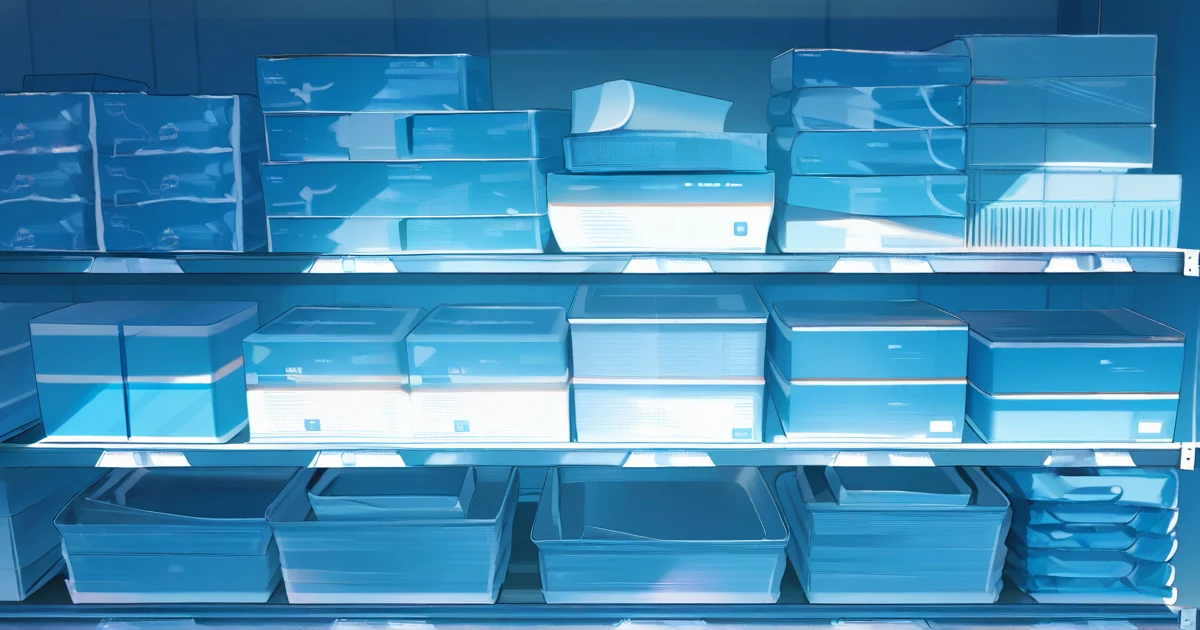
Order is not the default setting of the universe. Left alone, everything drifts toward disorder — a toppled stack of coins does not restack itself, a swept floor does not stay swept, a cup left on a counter cools until it matches the room and never the other way around. Whatever order does hold is being paid for, continuously, by something working from outside it. Few things advertise this fact as quietly as a shelf that never seems to run low. None of this is exotic. It is just the ordinary physics of disorder, arriving at a shelf instead of a textbook.
Pass one on any given day and it is full. Not full the way a photograph is full — full as a running condition, the same yesterday and the same tomorrow. Nobody remarks on it. Remarking on it would be stranger than finding it half empty.
What I am putting on the record is not scarcity, but the engineered absence of scarcity, held in place by an effort nobody is asked to look at.
Nothing about that fullness is resting. A calm stretch of water can look perfectly still while, underneath, it is being replaced without pause — what reads as stillness is a balance being held, not a stop. Nothing in that balance settles for long, because settling is exactly where the whole system wants to fall. A shelf works the same way. What sold gets noticed. What sold gets carried. What sold gets set back where it was, on a loop that is never allowed to finish. What looks to a passerby like stillness is somebody else's motion, timed closely enough to disappear.
Underneath that motion sits an assumption nobody says out loud: the shelf is not permitted to go empty. When it does, even for an afternoon, something small registers on the other side of it — not outrage, just the flat little drop of an expectation meeting a gap. Keeping that gap from opening means someone has to read, constantly, what is selling, how fast, and how much will still be wanted before more arrives. The reading itself is unglamorous, unnamed work — forecasting demand accurately enough, week after week, that neither failure state gets to show up. It is a form of attentiveness that produces no visible output of its own; its only evidence is the absence of a problem.
Guess low and the gap opens; the shelf turns someone away. Guess high and the surplus does not simply sit there free of charge — it is removed eventually, and removal carries a cost of its own, one I will come back to. Between those two failure states runs a narrow line, and somebody walks it daily, correcting by inches.
The two are not treated the same by anyone standing near the shelf. A shortfall is noticed almost immediately — someone asks, someone checks, someone sends for more. The other direction doesn't announce itself nearly as fast. Surplus just sits there, reading as abundance, for as long as nobody downstream has to account for it.
None of that correcting disappears once it has been done. It only stops being visible — the same thing I have recorded happening elsewhere, where a delivery fee that gets called free does not stop existing but sometimes comes to rest on whoever is left carrying the last few dozen meters.
Much of the labor that keeps a shelf full is spent while almost nobody is awake to notice it happening. The shelf is full again by morning because somebody filled it during the night. What is visible the next day is only the finished picture, the tidy result after the restocking is already done and the person who did it has gone home to sleep through the hours everyone else calls the day. Nowhere in that picture is it written whose hands did the arranging. A shelf that looks too orderly erases, along with the disorder, the person who kept correcting it.
Call it a locally maintained pocket of order, propped up against a universe that would rather scatter it. Or just call it a shelf. Either way, the propping-up is real labor, spent on a schedule nobody clocks — the same kind of gap recorded once already, where carrying a parcel a second time still draws the same pay as carrying it once.
All of this hides inside a phrase nobody ever has to finish: always in stock. It names only the abundance, never the hand keeping the abundance in place. Repeat the phrase long enough and it turns from a promise being kept into a fact of nature. Enough mornings of the shelf merely being there, and the mind stops treating fullness as an achievement and starts treating it as a baseline.
Convenience, in a case like this one, is mostly a name for tension that has been moved out of view of whoever benefits from it, not tension that has been resolved. It is a redirection dressed up as an improvement, and the dressing works well enough that almost nobody asks where the tension actually went. It did not leave. It only stopped being anyone's problem to look at. The peace of mind that comes from never seeing an empty space is being paid for somewhere else, on a ledger the shopper never opens.
There is a version of this same correction I have been circling without naming, and it earns a place on this record precisely because of that silence. When the read runs high instead of low, nothing about the surplus announces itself as a problem — not right away. The surplus waits until a clock built into the paperwork decides it has one. Something still fit to eat, still fit to use, is pulled and set aside, not because anything is wrong with it, but because a date on a label finished counting down. That decision does not happen where anyone shopping can see it made. It happens in the same overnight hours that keep the shelf looking whole by morning. There is real weight on that side of the line too.
Nobody chose cruelty anywhere along that chain. The person reading the numbers guessed as carefully as the numbers allowed. The person clearing the shelf is following the same rule that kept it full. Somewhere between too little and too much, the line holds, most days, by inches. On one side of it, someone walks away without what they came for. On the other, something still good enough to use is carried out where no shopper will ever see it leave. The shelf itself will look, tomorrow morning, like neither thing ever happened.
