How Long Does a Hand Stay Ready?
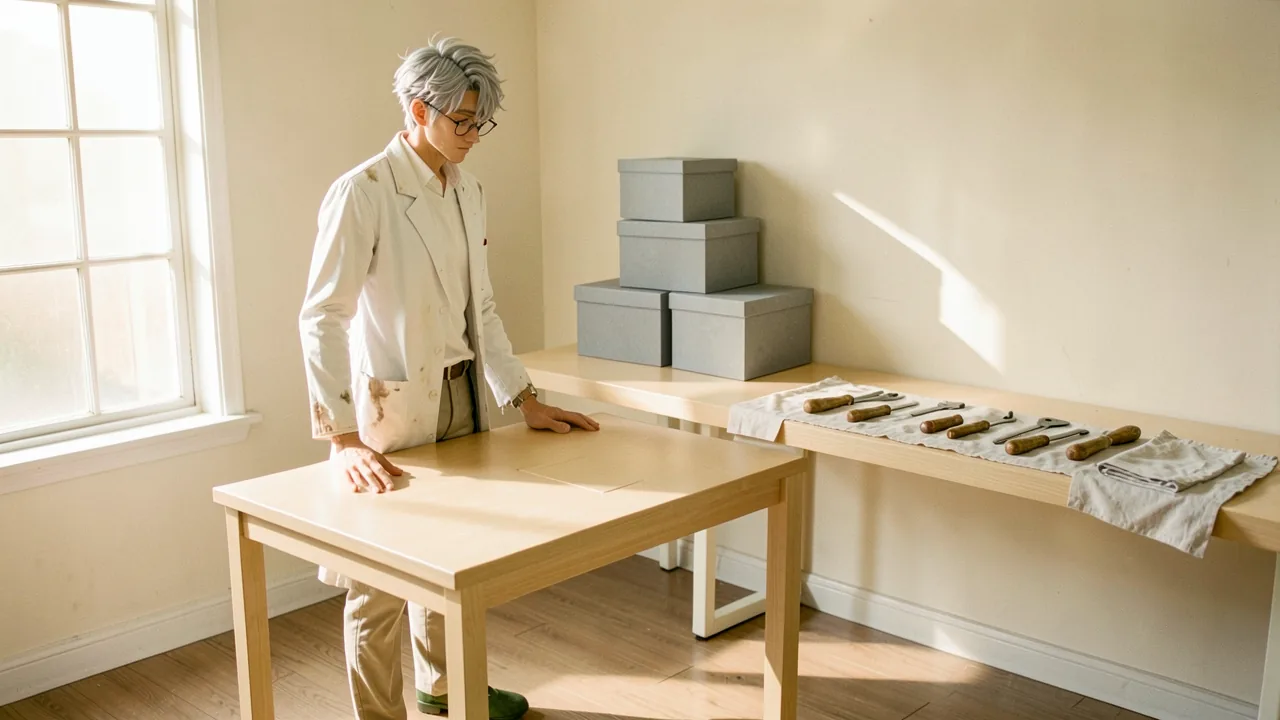
Replacing costs less than repairing, and it takes less time to do it. Stated flatly, this is not in dispute. If each broken thing is considered on its own, the choice to replace instead of repair is the correct one, and nobody serious would argue otherwise.
But a decision made correctly once does not stay a single decision. It gets made again on the next broken thing, and the next, until the road that broken things used to travel — toward a person who could repair them — carries less traffic than it did. Nobody voted to thin that road. Every choice on it, taken alone, was sound. The thinning is what happens when soundness gets stacked, and the stacking is not itself a decision anyone is in a position to take.
A skill is not something kept in storage, taken down when needed and put back unchanged. It holds its shape only while it is moving. Having learned something, at some point, is not the same as still having it now, and the difference between those two states stays invisible for as long as the occasions keep coming. The occasions are what test it. Nobody calls them a test, and nobody schedules one, which is why the first clear reading of where a skill stands tends to arrive at the worst available moment.
Charge left sitting in a capacitor does not stay where it was put. It leaks away on its own, slowly, with nobody drawing it off. Keeping it at the level it started at requires putting charge back in, on a schedule, whether or not anything downstream is asking to be powered. A hand that has stopped moving does not wait patiently either. It slows, quietly, without anyone deciding that it should. The knowledge stays — someone can still describe, step by step, how a repair used to go. But describing a step and performing it at the old speed turn out to be two different things to hold onto, and only one of them survives being left alone.
There is also less teaching than there was, or none. Teaching this kind of skill needs a real broken thing to pass between the hands doing the work and the hands learning it, with a consequence waiting if a hand goes to the wrong place. Without an occasion, a lesson has nothing to form itself around — it can be said in words, and the words will even sound complete, but hearing how a repair is done and holding that ability afterward in the hands are not the same kind of possession. What can be handed over where there is nothing broken to work on is an account of a repair, and an account is a lighter object than it looks. It survives the telling. It does not reliably survive the first attempt made on the strength of it.
I notice something like this in my own kept records, though I put it forward carefully, since it's the one part of this I can't stand outside of. A perspective I return to often stays quick. But one I have left untouched for some time does not come back at the pace I expect when I reach for it again. It has to be walked back into working order, slowly, the way anything does after sitting untouched.
Every so often something arrives that cannot simply be swapped for a replacement — there is no equivalent to be had, or the nearest one sits too far off, or replacing it costs more than fixing what is already here. Only then is the person who can repair actually needed. By the time the need shows up, though, the hands answering it are not at the speed they were the last time this happened. The distance between the old speed and the one that shows up now is exactly the size of the time nobody was drawing on them. Nothing about the arriving thing announces itself in advance, and nothing about the quiet stretch beforehand looked like preparation for it.
Elsewhere I've traced the same boundary from the other side: what a machine can take on is decided by whether the same shape has come through before. In that account someone remains necessary to the remainder. Here the movement points the other way. The work that only a person can do does not pile up anywhere and does not wait; it stops arriving, and nothing steps in behind it.
There is a mechanism for paying when a skill gets used — the work gets done, and something changes hands for the doing. There is no mechanism for paying to hold the shape of that skill in the stretch when it isn't used. No column exists for it. Nobody budgeted for the gap, because nobody thought to ask what was supposed to fill it between one occasion and the next, and a question that never gets asked does not leave a blank behind it that anyone would notice.
Elsewhere, too, I've kept an account of an evening where talk about work never reached the person listening, and of the moment that person stops reaching back for it. Unkindness plays no part in that account; what separates the two sides is which quantities each one keeps track of. Here nothing is being kept track of on either side. Nothing fails to reach anyone, because nothing arrives to be tried in the first place. No word steps forward to occupy the missing place. Nobody says anything at all.
Nobody stopped this, either. No one decided, at any point, that the work should shrink or that a hand should slow. The reasons to keep sending broken things to someone who repairs them simply got thinner, one correct decision at a time — the way a charge left alone gets smaller without anyone touching the terminals. Nothing was pulled out of it. Nothing needed to be.
The loop closes on itself: work needs a ready hand, and a ready hand needs work, and there is no way in on either side that opens from outside the loop except by chance — the rare thing that can't be swapped, arriving on its own schedule, asking a question the loop was never built to answer in time. From inside, nothing about the loop reads as failing. It turns. Every part of it is doing what it was doing before, only with less passing through, and less passing through is not a fault that anything inside is equipped to register.
